


How to Select Weights of Corresponding Grades for Calibrating Balances of Different Grades?
Daicy 2026-01-31 15:00:15

In scenarios such as laboratory testing, industrial production, foreign trade metrology, and precision jewelry weighing, the calibration accuracy of electronic balances directly determines the reliability of measurement data. As the core standard instrument for balance calibration, the scientific matching between the grade of weights and the grade of balances is the key to ensuring metrological traceability and meeting industry standards and international compliance requirements. Many users often encounter problems such as "invalid calibration caused by incorrect weight grade selection" and "failure to meet the metrological certification requirements of foreign trade customers" in practical operation. Based on international general metrological standards and industry practical specifications, this paper analyzes in detail the weight selection logic, matching standards and application points for balances of different grades, providing a full-process guide for precision calibration.
I. Core Standard Basis: Classification System of Balance and Weight Grades
The classification of balance and weight grades follows international general metrological specifications. Among them, weights are based on the OIML R111 (International Organization of Legal Metrology) standard, and balances are classified according to division value and precision index. The corresponding relationship between their grades must strictly follow the "error transfer" principle in metrology, which is the basic premise for selection.
(I) Classification of Weight Grades (OIML R111 Standard, Universal for Foreign Trade/Laboratory)
OIML R111 classifies weights into seven grades from high to low precision: E1, E2, F1, F2, M1, M2, M3. The smaller the grade number, the smaller the Maximum Permissible Error (MPE) and the higher the precision. Different grades are suitable for calibration scenarios with different precision requirements:
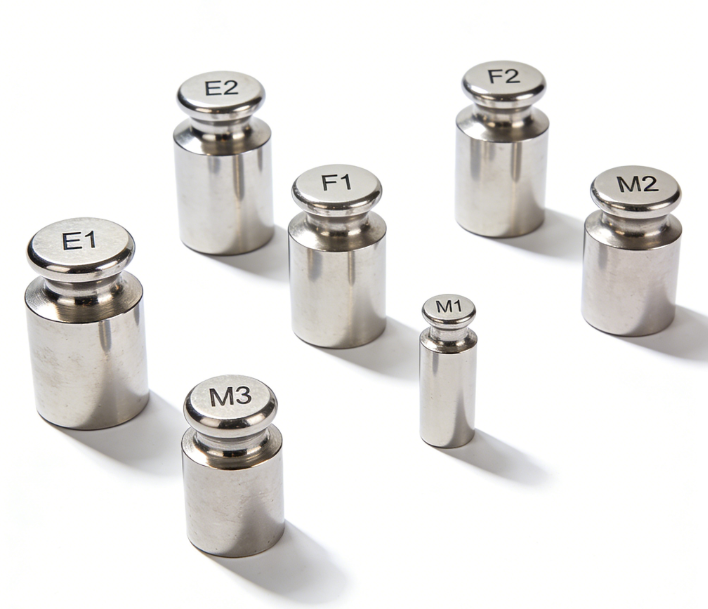
Grade E (E1, E2): Reference and first-class standard weights, made of non-magnetic stainless steel, with low magnetic susceptibility, corrosion resistance and minimal tolerance, used for highest-precision metrological traceability;
Grade F (F1, F2) : Second-class standard and industrial precision weights, made of stainless steel, balancing precision and durability, suitable for routine laboratory calibration and enterprise quality inspection;
Grade M (M1, M2, M3): Industrial general-purpose weights, made of cast iron/stainless steel, with low cost and high durability, used for low-precision scenarios such as industrial rough measurement and warehouse metrology.
(II) Classification of Balance Grades (Classified by Division Value and Application Scenarios)
According to the ratio of division value (d, the minimum measurement unit of the balance) to maximum weighing capacity, combined with application scenarios, balances are mainly divided into four categories, covering all scenario needs from scientific research laboratories to industrial production:
Micro/Semi-micro Balances: Division value d≤0.01mg (0.00001g), used in national metrological laboratories, high-end scientific research, and precise calibration of precious metals;
Analytical Balances: Division value d=0.1mg (0.0001g), used in precision testing such as third-party testing, pharmaceutical laboratories, and jewelry appraisal centers;
Precision Balances: Division value d=1mg (0.001g), used in enterprise quality inspection, routine laboratory analysis, and factory calibration of electronic scales;
Industrial Balances: Division value d≥0.01g (10mg), including 0.01g, 0.1g division balances and large-capacity platform scales, used in production feeding, warehouse inventory, and foreign trade shipment metrology.
II. Core of Precision Matching: Weight Selection Standards for Balances of Different Grades
The general metrological principle requires: The Maximum Permissible Error (MPE) of calibration weights ≤ 1/3 of the MPE of the calibrated balance to avoid interference of the weight's own error on the calibration results. Based on this principle, the corresponding relationship of weight selection for balances of different grades is as follows, covering special scenario needs such as foreign trade export and laboratory certification:
Balance Type | Typical Division Value (d) | Recommended Weight Grade | Core Matching Logic |
Micro/Semi-micro Balances | d≤0.01mg | Grade E1 | The balance has minimal tolerance and requires reference-grade weights for traceability. The tolerance of Grade E1 is only 1/3~1/5 of the balance's tolerance, meeting the highest precision calibration requirements |
Analytical Balances | d=0.1mg | Grade E2 (Priority)/Grade E1 (High Requirements) | The tolerance of Grade E2 perfectly matches the precision of analytical balances, being the first choice for routine calibration; Grade E1 is used for third-party certification scenarios requiring higher traceability |
Precision Balances | d=1mg | Grade F1 (Priority)/Grade E2 (High Requirements) | The precision of Grade F1 covers routine precision calibration needs with optimal cost performance; Grade E2 is used for scenarios where foreign trade customers require high-grade certification |
0.01g Division Industrial Balances | d=0.01g | Grade F2 | The tolerance of Grade F2 adapts to 0.01g division balances, meeting the calibration compliance of industrial precision weighing |
0.1g Division/Platform Industrial Balances | d=0.1g | Grade M1 | Grade M1 is an industrial general-purpose standard weight, with tolerance matching low-precision industrial balances, low cost and high durability |
Large-capacity Industrial Scales (Above 1kg) | d≥1g | Grade M2 (Routine)/Grade M1 (High Requirements) | Large-capacity balances have low precision requirements, and Grade M2 meets basic calibration; Grade M1 is used for industrial metrology scenarios requiring compliance filing |
III. Key Practical Points: Core Precautions Beyond Grade Matching
(I) Range Matching: Total Weight Mass Must Cover the Core Range of the Balance
Calibration requires not only grade matching but also range compliance: The total mass of calibration weights ≥ 1/3~1/2 of the balance's maximum weighing capacity. A single weight close to the balance's maximum weighing capacity is preferred to calibrate the center point, and then small weights are used to calibrate the linearity of the full range to avoid measurement deviations within the range caused by "single-point calibration". For example, to calibrate a 500g/0.001g precision balance, a 500g Grade F1 weight should be used as the main standard, with 200g, 100g, and 50g Grade F1 weights to calibrate linearity.
(II) Material and Environment Adaptation: Ensuring the Stability of Weight Precision
The materials of weights of different grades adapt to different use environments, directly affecting the durability of calibration precision:
High-precision weights of Grade E1/E2: Must be made of non-magnetic stainless steel and used in constant temperature and humidity laboratories (temperature 20℃±2℃, humidity 45%~65%) to avoid precision drift caused by magnetic field, temperature and humidity changes;
General-purpose weights of Grade F1/F2: Mainly made of 304 stainless steel, suitable for routine laboratories and factory quality inspection workshops, with daily dust and corrosion protection;
Industrial weights of Grade M1/M2: Made of cast iron chrome-plated/stainless steel, impact-resistant and wear-resistant, suitable for non-constant temperature environments such as workshops and warehouses without strict environmental requirements.
IV. Summary: Precision Selection Formula and Practical Suggestions
The weight selection for balance calibration follows three core principles: "grade matching, range adaptation, traceability compliance".with the continuous upgrading of metrological standards and the tightening of foreign trade compliance requirements, the precise matching of balances and weights will become a core link in enterprise metrological management. Only by following international standards and standardizing practical processes can precise metrology and compliant operation be achieved in various scenarios.
If you have a need to purchase weights of different classes, please visit our website:www.bdscales.com or contact our sales team for more details !


